

I’m about to head back to the airport, I’m in New Orleans, and I wanted to share a question a student asked me in class. I think it happens quite frankly, so hopefully you get some value out of this.
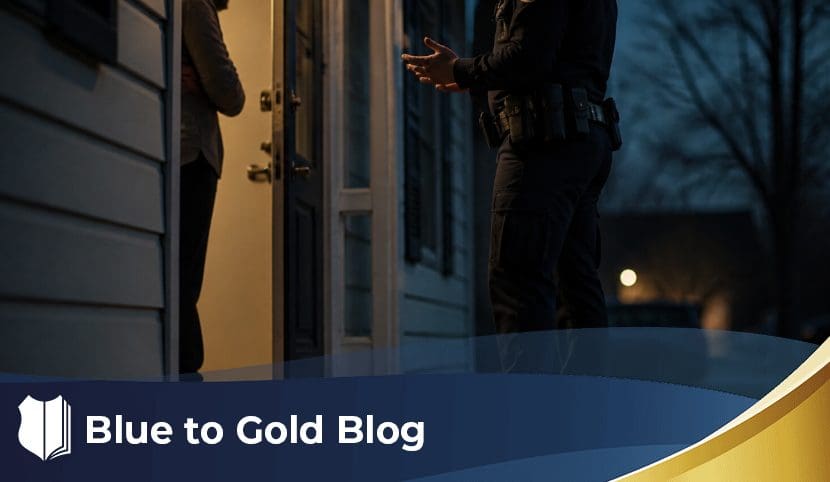
The question is whether officers conducting a knock and talk may put their foot in the front door in order to chock it open while talking to the occupant, without implicating the Fourth Amendment.
The short answer is no. That does implicate the Fourth Amendment.
And if it does, the officer needs what’s called CREW. It’s an acronym I came up with that stands for consent, a recognized exception, or a warrant. You need one of those in order to do something that implicates the Fourth Amendment.
Now with that answer, let’s roll into the why.
Reason one: you’re doing it to see inside
Chocking open the front door, putting your foot there to prevent them from closing it, is done for one of two purposes.
One, the officer may be trying to search. To look around inside the house and see plain view evidence.
Well, the plain view evidence rule applies when an officer is lawfully present and then sees, hears or smells something that gives him probable cause. The better way of saying plain view is right to be, right to see.
So does the officer have a right to chock open the door with his foot to get a better look into the home?
Of course the answer is no. Because that is a home, and it is clearly protected by the Fourth Amendment. It is the most protected area under the Fourth Amendment. Before you can do that, you have to have more reason than simply “I really just don’t want this person to close the door on me, because I want to talk to him.”
So if the officer’s motive is to search, and they chock open a door, it’s not plain view. It is a search under the Fourth Amendment.
Reason two: you’re doing it to stop them closing the door
The other reason some officers do this is to prevent the occupant from closing the door before the conversation is over.
But again, preventing a person from closing their front door is activity implicating the Fourth Amendment. This would be a seizure.
A seizure occurs when an officer intentionally interferes with the possessory interest a person has in their property.
The occupant is lawfully present in that home. Therefore they have a right to close the door and not talk to police. That is a constitutional right. They do not have a constitutional mandate to cooperate with police.
So if they choose to close the door, that is their choice. And if the officer prevents that, they are interfering with their possessory interest in the home, which implicates the Fourth Amendment.
So run CREW
Do you have consent? Surely not, because the person wants to close the door and you’re not letting them.
Do you have a recognized exception? You may, but you’d better come up with something.
Do you have exigency? Do you have an arrest warrant? Do you have community caretaking? That seems a little weak if they’re up and about and talking to you at the door.
But if you’re investigating a domestic violence call, and the husband is trying to close the door on you, and you’re trying to make sure the wife is okay. That would be a recognized exception.
And do you have a warrant? Which you wouldn’t, or we wouldn’t be having this conversation.
So I hope this helps. It’s a great question, keep them coming.
Thank you, and stay safe.
Related from Blue to Gold
- Can an Officer Enter a Garage Just to Close It?
- Constitutional Considerations of Warrantless “Surround and Call-Outs”
- Security Door Knock and Talk
This article is an edited transcript of Roadside Chat Ep. #20. It is legal training, not legal advice. Check your state law and your agency policy, because both can be more restrictive than the Fourth Amendment.