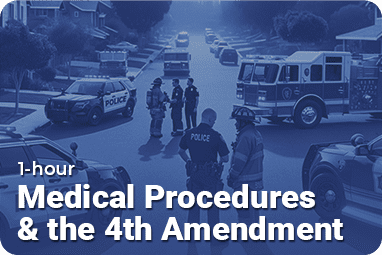


This question came in from an officer in Tennessee. EMS was forcing a subject to go to the hospital against their will and asked police to help escort the subject to the ambulance, which may require force because they were refusing to go. The officer added that the subject was not doing anything criminally wrong and did not qualify as emergency detention.
Can you help EMS involuntarily transport that person to the hospital for medical care, even if the patient does not want to go?
What an amazing question, right? I can only imagine if I was on scene here and you’re like, man, what am I going to do here?
What should you do first if you don’t know whether you can help EMS?
Let me just tell you one quick piece of advice. If you are in this situation and you’re like, man, I don’t know, I don’t know what to do, I don’t have Anthony on my shoulder over here, what am I gonna do here? I think that the first thing that you should start thinking about is keeping the scene safe. If this person is combative and so forth, we want everybody to be safe.
But you need to start making some phone calls. You need to start asking higher ups, like, what do you want me to do here? I’m not sure what to do here. We can’t civilly commit this person. What do you want me to do? And then let the bosses decide. I just think that’s an important thing to say, because part of their job when you have three stripes and bars and stars is to make decisions like this.
Do police need their own legal authority to help EMS transport someone?
Now let’s go through the law. I think the first thing that we can agree on is that you are going to need a law to enable you to do this. We are not the henchmen, the bodyguards, the muscle of EMS. If they have their own medical protocols and they are allowed to involuntarily transport somebody against their will, in other words they have their own rules, they have their own liabilities. We need to make sure that we’re acting in our own sandbox here. We’re not EMS. We don’t have their rules. We don’t have their medical training.
And quite frankly, I’ve taught some EMS folks some Fourth Amendment issues and due process issues, but that’s not our sandbox. And so what law are you enforcing?
I got to tell you, look, my advice, and I’m not giving you legal advice here, I’m just giving you some legal education, because I can understand that this situation could be a little tough. But my thing is, what law are we allowed to enforce here?
Does the law have to be a criminal law?
Now it doesn’t have to be criminal, and let me explain what I mean by this. It can be civil. Civil commitments. If a person has a mental crisis and they are a danger to themselves or others and they are going to get involuntarily committed to a hospital, that is obviously not a criminal issue. However, if you’re in line with the law, can you still force them to go to the hospital? The answer is yes.
What does Tennessee’s emergency detention statute say?
So what I want to do here is look at a code, and let me just kind of show you what I have. Tennessee code. There’s a few codes here, mainly 33-6-401 all the way to 427, but this is actually 401, emergency detention.
And it says here, it says if and only if. Man, Tennessee don’t play when they write their codes, right? They have a way of talking. They’re like, listen here dummy, we’re going to make it very plain for you.
If a person has a mental illness or a serious emotional disturbance, and the person poses an imminent substantial likelihood of serious harm under 501, which we have to read to get that, because of the mental illness or serious emotional disturbance, then they make it very easy. This is like Boolean logic here. If, then, ends. The person may be detained to obtain examination for certification of need for care and treatment. So this is basically Tennessee’s civil commitment statute.
Is being highly intoxicated a mental illness?
So let’s look at this with the facts presented so far. The person has a mental illness? Well, I am not aware of any cases or interpretations that being highly intoxicated is actually a mental illness. It’s just not.
Yeah, being an alcoholic can be considered a mental illness, but that’s not why they’re going to the hospital. You’re not going to the hospital for being an alcoholic. You’re not being civilly committed for being an alcoholic. You’re not being civilly committed because you’re a drug addict. You’re being committed because you have some mental illness.
Does being drunk count as a serious emotional disturbance?
So the next thing is, or a serious emotional disturbance. I have not done research on how Tennessee defines a serious emotional disturbance, but I don’t think it means being highly intoxicated. I really don’t. I don’t think that that’s what the legislature meant.
They’re talking about a behavioral health emergency. They’re talking about that excited delirium situation. They’re talking about people who, though they may not be mentally ill, are contemplating suicide. They’re contemplating an active shooter event. They’re thinking about killing their boss because they didn’t get that raise. That’s a serious emotional disturbance. Even though in all respects they actually may be as sane as you and me, something triggered them and they’re having a very, very bad day.
So I do not think that this 401 applies to the person that’s highly intoxicated and falling over in the street.
Is there a drunk in public statute that lets you detain someone to dry out?
Now the next thing, which I have not found yet in Tennessee but I’m hoping it exists, is this. Do you have a drunk in public statute? I’m talking to my Tennessee folks. That would allow you to detain a person to dry out.
So for example, Nevada, which is where I’m from. Nevada has a revised statute that would allow police to involuntarily take people off the street that are so intoxicated that they’re falling over drunk and they’re going to fall in the travel lane and they cannot care for themselves. It’s not like they’re committing suicide. In fact, maybe they’re the opposite. Maybe they’re happy drunk, but they just can’t control themselves. Nevada allows police to assist in that transportation.
Now we don’t bring them to jail. Look, many places the jail is where people dry out. But a lot of cities, big cities especially, they go to some kind of clinic, or they go to kind of like a group home. We call it in Nevada, we call it WestCare. At least in Las Vegas they go to WestCare. There’s a little bed there and they just dry out and they’re monitored and they give them fluids, and if they need to throw up there’s a little barf bag right there and so forth. But the point is, they don’t get charged with anything, and it’s against their will, but it’s for their safety.
So can police force an intoxicated person to the ER?
So I guess my point here is this. I agree with the officer that being highly intoxicated does not qualify to be civilly committed for a mental illness. That’s not what’s going on here.
However, do you have a statute in Tennessee, or do you have an ordinance, that would allow the person to be detained temporarily because they’re just so intoxicated? I think that most states have something on the books that allow this. Otherwise you have this conundrum we’re talking about right now.
If you know what that law is, put it in the comments. I would love to know if you know what that law is. Please share with me. I just wasn’t able to find it tonight, but I’m sure there’s something out there. That’s why I got my Blue to Gold Mafia peeps, my captains out there that are going to have my back.
But that’s the answer. Be very careful. I think you should have a law. If you don’t have a law that enables you to do this, I would caution you that you probably should be light hands, because at the end of the day it’s a lot more tempting to sue a police officer than the EMS person, because you have a lot more rules to control your behavior than EMS.
So that’s my answer. I hope it helps. This is just contributing to the conversation. Thank you for what you guys do out there. What a tough job, especially for situations like this. Until next time my friends, you stay safe.
The short version
- You are going to need a law to enable you to do this. We are not the henchmen, the bodyguards, the muscle of EMS.
- It doesn’t have to be criminal. It can be civil. If a person has a mental crisis and they are a danger to themselves or others, that is obviously not a criminal issue.
- I am not aware of any cases or interpretations that being highly intoxicated is actually a mental illness.
- I don’t think a serious emotional disturbance means being highly intoxicated. They’re talking about a behavioral health emergency.
- Do you have a drunk in public statute? That would allow you to detain a person to dry out.
- You need to start making some phone calls. Part of their job, when you have three stripes and bars and stars, is to make decisions like this.
- If you don’t have a law that enables you to do this, I would caution you that you probably should be light hands.
Related from Blue to Gold
- Entering a Home to Seize a Person For a Mental Evaluation
- Case v. Montana: The U.S. Supreme Court Clarifies the Legal Standard for Warrantless Home Entry to Render Emergency Aid
- When Can Police Force Entry on a Suicidal Subject Call?
This article is an edited transcript of Roadside Chat Ep. #718. It is legal training, not legal advice. Check your state law and your agency policy, because both can be more restrictive than the Fourth Amendment.